
Connor Oger ’25
Contributor
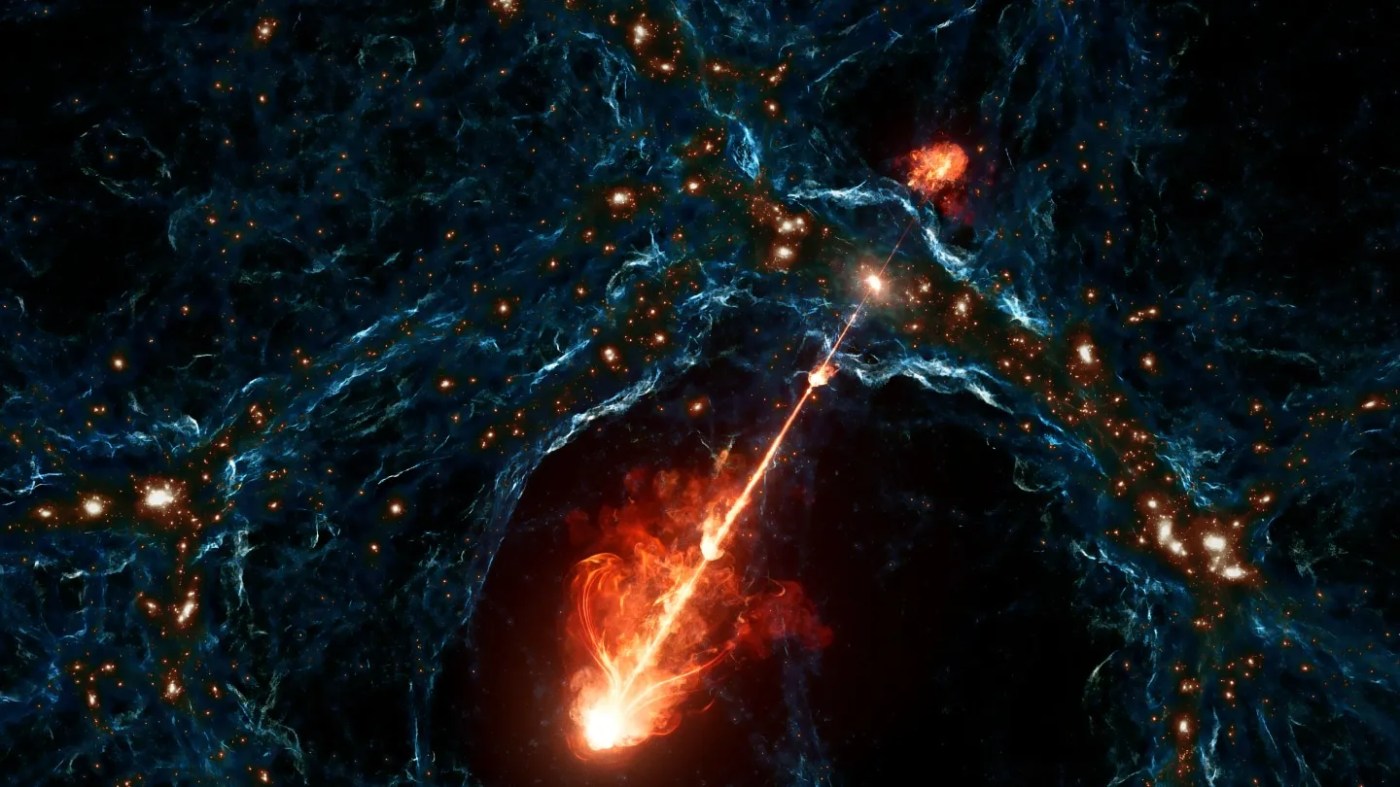
Photo Credit: E. Wernquist, M. Oei, D. Nelson/Illustristng Collaboration
On September 19 of this year, the featured cover article in the scientific journal Nature was the discovery of what co-author and astronomer at the University of Hertfordshire, Hardcastle, called “possibly the largest object that we know of in the universe”. Named “Porphyrion” after a giant in Greek mythology, this supermassive black hole was discovered at the center of a galaxy roughly 7.5 billion light-years away from Earth. Dating to when the universe was just 6.3 billion years old, half its current age, this black hole emitted two enormous plasma jets that pulverized the record for the longest ever recorded. With a span of 23 million light-years, it would take one hundred and forty Milky Ways in laid lengthwise to match its size.
Led by California Institute of Technology astrophysicist Martijn Oei, the research used the Low-Frequency Array Radio Telescope (LOFAR) to observe the Cosmic Web (a large structure that links intergalactic space) but instead discovered ten thousand new pairs of massive plasma jets which are emitted by black holes. In its infancy, the universe existed as a hot, crowded place. Due to its size, Porphyrion’s plasma jets have expanded beyond its host galaxy, invading greater portions of the Cosmic Web. This has led scientists to theorize that Porphyrion may have heavily impacted the universe’s early growth. “If distant jets like these can reach the scale of the cosmic web, then every place in the universe may have been affected by black hole activity at some point in cosmic time,” states Oei.
As research progresses, shocking discoveries made through Porphyrion have caused the scientific community to doubt even the limited knowledge we have about black holes. Porphyrion is a radioactive type of black hole, one that prefers releasing energy through radiation and aggressive solar winds instead of plasma jets. Hardcastle posits, “What we’re learning from the large number of giants [large plasma jets] is that this must be a relatively common occurrence.” Oei is also curious about how these far-reaching jets have influenced their environment, specifically how they have spread magnetism. Magnetism is an important part of the universe as it allows planets such as ours to survive, but its origin is an ongoing mystery that these jets could provide a clue to.
These new studies have suggested that radioactive black holes may be just as capable of jet pulses as traditional jet-mode black holes. It is now known that this is also a long-standing occurrence, having existed for most of the universe’s inception. LOFAR has covered 15% of the night sky, thus far leaving much room for the discovery of more behemoth structures through the unravelling of the mysteries of the universe.
 The Crusader News