
Thomas Bernardin ’25
Contributor
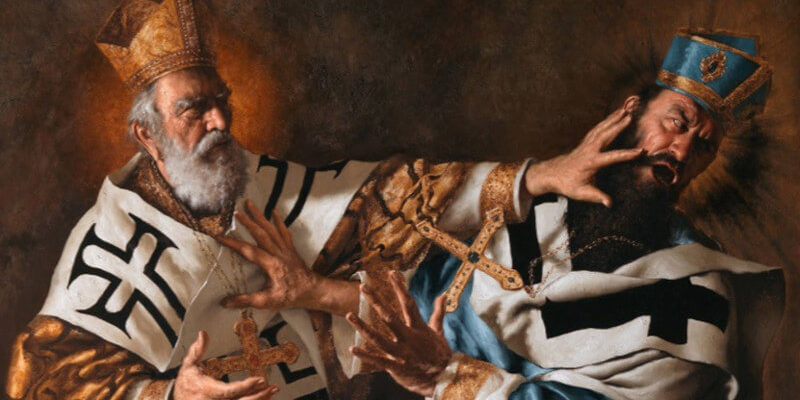
St. Nicholas is known for his charity and generosity, the inspiration for the Christmas legend, Santa Claus. Whatever he is known for, he is appreciated by Christians and non-Christians alike. What many do not know about him, however, is that he was rumoured to have punched the leader of an incredibly famous heresy.
The first ecumenical council of 325 was a meeting of bishops to discuss and decide on the doctrinal matters of the church. The first seven ecumenical councils were called by the Roman Empire of the time, and the Council of Nicaea was called by Roman Emperor Constantine. The council of Nicaea was tasked with determining the divine nature of the Son and the relationship between God the Father and God the Son. The two parties of the supposed brawl were St. Nicholas,who was a bishop at the time, and an early Church father who was venerated in the Catholic, Orthodox, and Anglican churches. St. Nicholas believed in and defended what is now known as Nicene Orthodoxy. Nicene Orthodoxy is the set of beliefs outlined in the “Nicene Creed” which proclaimed Jesus as uncreated, eternal, and coequal with the Father through His divine presence. This stance is held by most Christian churches in the world, most commonly by Catholicism and Orthodoxy.
St. Nicholas’s “punching bag” was Arius. Arius was a Christian priest who lived in Alexandria in the early fourth century. Arius advocated a unique position that was later named after him: Arianism. Arianism is the belief that the second person of the Trinity is divine, but a created being, and that the Son is not co-equal with the Father. This belief has become less popular but is still held by Christian denominations such as Jehovah’s Witness. St. Nicholas’s belief was the consensus among the bishops, and the Nicene Creed was formed, and Arius was branded a heretic.
The tale is believed to have happened when Arius was spouting his beliefs on the roles of the Trinity. St. Nicholas became so aggravated that he punched him directly in the mouth. This was not an act of sin, as St. Nicholas was merely warning Arius of his false teaching and was only trying to save his soul. Unfortunately for St. Nicholas, Arius did not retract his position. There is much discussion and debate over whether St. Nicholas punched Arius or not. While many Catholic and Orthodox sources agree that this did in fact happen, many historians believe that this story is simply an entertaining myth, as there is very minimal historical evidence for this.
It is a hotly debated topic regarding whether Arius was punched by St. Nicholas during the Council of Nicaea, having been scrutinized by skeptics. This is, nevertheless, a fun passing thought and is always a conversation starter amongst Christians interested in the Early Church. Christians should view St. Nicholas as a role model and appreciate how he showed his love for the Church and his desire to preserve true teaching. They should not follow his direct examples and throw down their uncle who politely disagrees with their beliefs.
 The Crusader News