
Castiel Haripersad ’25
Copy Editor
The moon, for millennia, has captivated our hearts and minds. We have studied it, praised it, and, as humans do with everything else, tried to find our meaning within it. The Apollo mission, one of humanity’s greatest achievements, allowed us to land on the moon, and NASA’s joint mission, Artemis, will see us return to it for the first time in fifty years.
Featuring a collaboration of the Canadian Space Agency, the European Space Agency, and various other space agencies, Artemis’ objective is to establish long-term crewed exploration on the moon. The mission was named Artemis after the Greek goddess of the moon, who is Apollo’s twin sister in Greek mythological tradition.
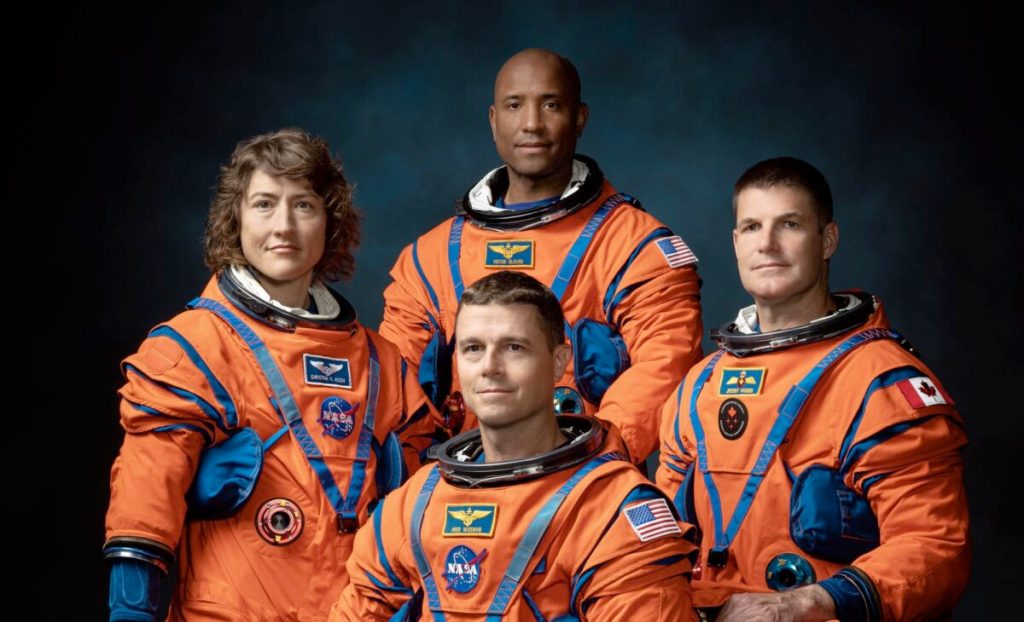
Artemis will be conducted in two missions, one of which, Artemis I, has already been completed. This initial mission tested the safety of the flight craft, landing gear, and re-entry, ensuring complete safety during the manned flight, which is set to launch in 2024. At the forefront of lunar exploration, the four astronauts aboard Artemis II include Reid Wiseman, Victor Glover, Christina Koch, and Jeremy Hansen, the last of which is the first Canadian ever aboard a lunar mission.
The mission also represents a breakthrough in space exploration with the development of the Space Launch System (SLS), which NASA claims is the most powerful rocket in the world. Designed to house four astronauts, the Orion module is at the centre of Artemis, and will be attached to SLS during launch. Upon leaving Earth’s orbit, Orion will detach from the SLS and go on a trajectory towards the moon.
One difference between the Apollo and Artemis missions is pre-staging. Since the goal of Artemis is long-term exploration, machinery, labs, and habitats, as well as a dedicated lunar space station called Gateway, will be set up in and around the moon for easy transportation. Once Orion reaches the moon, it will intercept with Gateway and take a lander down to the lunar surface.
Once the astronauts have collected data and resources, they will reconnect with Gateway and begin their journey back to Earth. This method is efficient because it ensures the conservation of fuel and the possibility of docking at a later point, creating a permanent port on the moon.
Lunar exploration could reveal untold secrets not only about Earth but about the Universe. The possibilities of finding deposits of rare or exotic minerals or knowledge about the formation of planets and stars has led many to call the moon a ‘hidden gold mine.’
Beyond that, returning to the moon could bring a little unification to a divided world. No matter who or where you are, at one point in your life, you have looked up at the night sky and seen the moon, whether as a subject of intrigue or ordinary life. Only time will tell whether the moon will once again captivate our hearts and minds, as it did fifty years ago.
 The Crusader News